
.png)
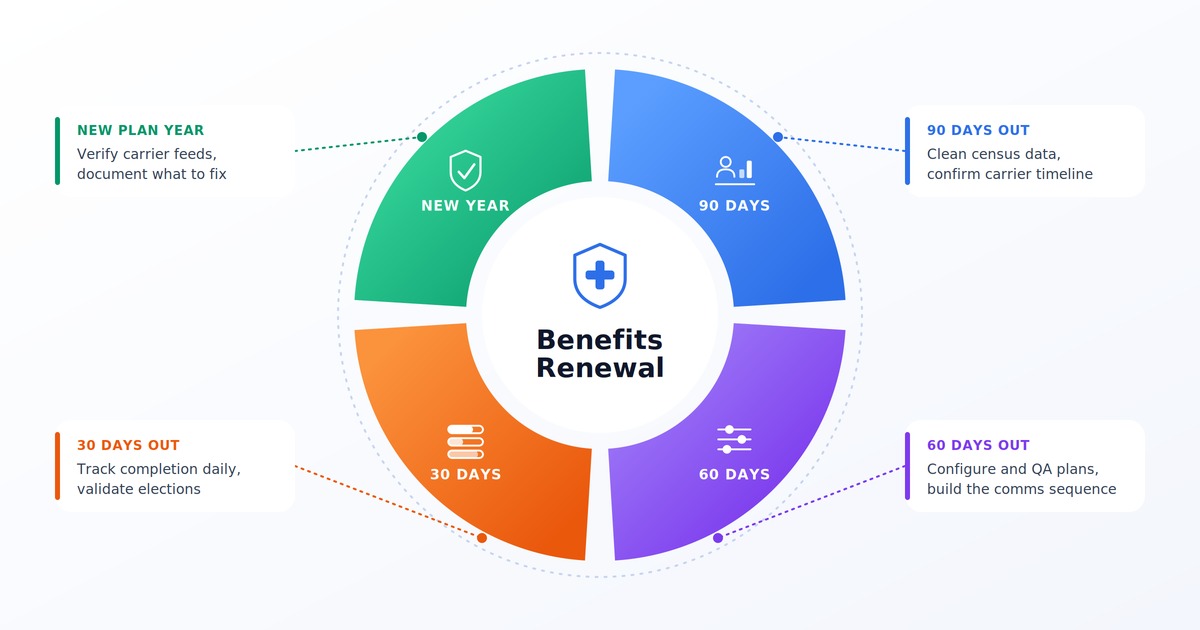
Benefits renewal is the annual project that HR teams dread for good reason. The window is tight, the stakes are high — a missed enrollment or misconfigured plan means a real person loses coverage they're counting on — and it lands on top of everything else Q4 demands. For most mid-market companies, it's also the moment when the limits of an under-configured HRIS become most painful.
This is a practical 90/60/30-day guide for HR and ops teams running benefits renewal on Rippling. It's not a benefits strategy piece — it's an operational playbook. The goal is to help you hit your renewal deadline without scrambling, missing enrollments, or surprising your CFO with a plan configuration that doesn't match what you signed with the carrier.
The biggest mistake in benefits renewal is treating it as an enrollment event rather than an operational project. Enrollment is the last two weeks. The real work starts 90 days out.
Pull your current census data from Rippling. Your carrier needs accurate employee census data to model renewal rates — name, date of birth, coverage tier, dependents, work location, and employment status. In Rippling, this data should live in structured fields connected to your benefits module. Before you send anything to your broker, run a data quality check: are there employees with missing DOBs? Incorrect dependent records? Terminated employees still showing as enrolled? Clean data now saves you a correction cycle later.
Review prior year enrollment outcomes. Pull last year's enrollment report from Rippling. What percentage of eligible employees enrolled? Where did people waive? Were there plans that nobody chose? If you're running medical, dental, vision, and voluntary benefits, look at utilization and cost data by plan. Your broker will have claims data — combine it with your enrollment data to identify whether you're offering the right plan mix.
Confirm your renewal timeline with your broker. Carrier renewals typically arrive 60–90 days before the plan renewal date. If your benefits year starts January 1, you should have carrier rates by mid-October. If your broker hasn't confirmed the timeline, ask now. A delayed rate delivery compresses your open enrollment window, which compresses your communication timeline, which leads to lower enrollment and more employee confusion.
Document your plan changes before touching Rippling. Before you make any configuration changes in Rippling Benefits, have a written record of exactly what is changing: new premiums, plan design changes (deductibles, out-of-pocket maximums, co-pays), new plans being added, plans being discontinued. This documentation becomes your QA checklist when you configure the new plans in the system.
At 60 days out, you should have your carrier rates and plan designs confirmed. Now the operational work in Rippling begins.
Configure new plans before archiving old ones. In Rippling Benefits, configure your new plan year plans completely — premiums, employee contribution splits, coverage tiers, eligibility rules — before deactivating the current year plans. Running both in parallel lets you QA the new configuration against the old one. When you're satisfied the new plans are correct, set the effective date and archive the prior year plans.
Validate eligibility rules. Eligibility in Rippling is controlled by employee groups, employment type, work location, and hours thresholds. If you've hired significantly or added new work locations since last renewal, your eligibility rules may no longer be accurate. Review them explicitly — the cost of accidentally excluding a newly eligible employee or extending eligibility to someone who shouldn't qualify is high in both human and financial terms.
Set up dependent verification if required. If your plan requires dependent verification (marriage certificates, birth certificates), Rippling can include a document request in the enrollment flow. Configure this at setup, not after open enrollment opens. Chasing dependent documentation after employees have already enrolled is a painful process.
Build your employee communication sequence. Open enrollment communication works best as a sequence, not a single announcement. A reasonable structure:
Six weeks before enrollment opens: "What's changing and why" communication. Cover any plan changes, premium changes, and why the company made the decisions it did. Employees who understand the context make better enrollment decisions and ask fewer support questions.
Two weeks before enrollment opens: "Here's how to enroll" communication. Step-by-step instructions, a link to the Rippling enrollment portal, a clear deadline, and contact information for questions. Include information on what happens if someone misses the window.
Enrollment period open: Reminder at the midpoint and three days before close. Track completion rates in Rippling and send targeted reminders to employees who haven't completed enrollment, not blanket reminders to the entire company.
Schedule a broker Q&A session. For most mid-market companies, a 30–60 minute live session where employees can ask benefits questions directly — before enrollment opens — meaningfully increases enrollment rates and reduces the individual support volume HR handles during the enrollment period. Schedule this for the week before enrollment opens.
With 30 days to your renewal deadline, open enrollment should either be open or opening within days. This phase is about completion rate management and exception handling — not configuration.
Monitor completion rates daily. In Rippling, you can track who has and hasn't completed benefits enrollment in real time. Build a daily cadence: pull the report each morning, identify non-completers, and trigger targeted reminders. Don't wait until the last three days to find out 40% of employees haven't enrolled — you won't have time to reach them all.
Have a documented exception process. Employees will miss the enrollment window. Life happens. Have a clear, documented policy for what happens when someone misses open enrollment — whether that's a hard lock until the next qualifying life event, a brief grace period, or a manager-escalation process for exceptions. Whatever your policy is, it should be consistent and communicated before enrollment opens, not decided ad hoc when the first exception request arrives.
Validate elections before the carrier deadline. Before you submit enrollment data to your carrier, validate it in Rippling. Check for employees enrolled in plans they're not eligible for. Check for dependent coverage without valid dependents on file. Check for employees who enrolled in both an HSA-eligible HDHP and a health FSA simultaneously (a common compliance error that creates IRS issues). Catching these before carrier submission is significantly easier than correcting them after.
Coordinate payroll deduction timing. Benefits premium deductions need to start on the correct payroll cycle for the new plan year. In Rippling, benefits and payroll are connected — premium deductions should update automatically when enrollment is finalized. Confirm this is working correctly before the first pay run of the new plan year, not after employees notice the wrong deduction amount on their pay stub.
Process qualifying life event (QLE) exceptions before close. If employees have had QLEs during the year — marriage, new dependent, loss of other coverage — and those changes haven't been processed in Rippling, your census data going to the carrier will be wrong. Run a QLE audit in the 30-day window and process any outstanding changes before finalizing enrollment.
Once open enrollment closes and the new plan year starts, most HR teams exhale and move on. Three things are worth doing in the first two weeks of the new plan year:
Confirm carrier feeds are running correctly. Rippling has carrier connections that transmit enrollment data to your insurance carriers. In the first week of the new plan year, confirm that your carrier has received and processed the correct enrollment data. Carrier feed errors are common after a plan change — catching them in week one versus week six (when an employee files a claim and discovers they're not enrolled) is a meaningful difference.
Archive prior year plan data cleanly. Make sure prior year plan configurations are properly archived in Rippling, not just deactivated. Clean plan data makes year-over-year comparison easier and prevents confusion when pulling historical enrollment reports.
Document what broke and what you'd do differently. While it's fresh, write down the two or three things that caused the most pain in this renewal cycle. Configuration gaps, communication timing issues, carrier coordination delays. These notes are gold when you start planning next year's renewal at 90 days out.
For companies that have historically managed benefits in a standalone platform or through a broker portal, the operational case for running benefits inside Rippling comes down to data integrity. When payroll, benefits, and HR data live in separate systems, every enrollment change requires a manual update in multiple places — and every discrepancy between systems is a potential compliance or payroll error.
In Rippling, an employee enrolling in a new plan tier during open enrollment automatically updates their payroll deduction. A qualifying life event processed in HR automatically opens the QLE enrollment window. A termination triggers the COBRA notice workflow. These connections don't happen by magic — they require correct configuration — but once configured, they eliminate an entire category of manual reconciliation work. Our piece on which Rippling modules you actually need covers the benefits module tradeoffs in more depth.
Benefits renewal doesn't have to be the annual sprint it often becomes. The companies that handle it smoothly aren't necessarily larger or better-resourced — they just start earlier and treat it as an operational project with explicit milestones, not an HR event that happens at the end of Q3.
The 90/60/30 framework above won't eliminate every surprise — carriers will deliver late, employees will miss deadlines, and something will need to be corrected in the carrier feed. But it reduces the frequency and severity of those surprises significantly.
If you want help configuring Rippling Benefits for your next renewal cycle or reviewing your current setup, get in touch with thePeopleStack team. This is the kind of work we do every day for growing companies.



December 24, 2025
Career
It's 2026, and career ladders are breaking down as flatter organizations, faster skill change, and AI reduce traditional promotion paths. Research shows high performers now grow by expanding scope, building in-demand skills, moving laterally, and earning trust through outcomes—not by waiting for titles. Employees must manage careers as portfolios of skills and impact, while PeopleOps and HR must redefine growth around scope and mobility, enable managers in leaner orgs, and ensure fair access to opportunity or risk losing top talent.
Career


November 28, 2024
Compliance
Upcoming 2025 employment law changes in the U.S. and Canada will significantly impact businesses, but Rippling’s automated compliance tools and robust HR features can help organizations stay ahead and confidently adapt to evolving regulations.
Compliance

July 11, 2026
Compliance
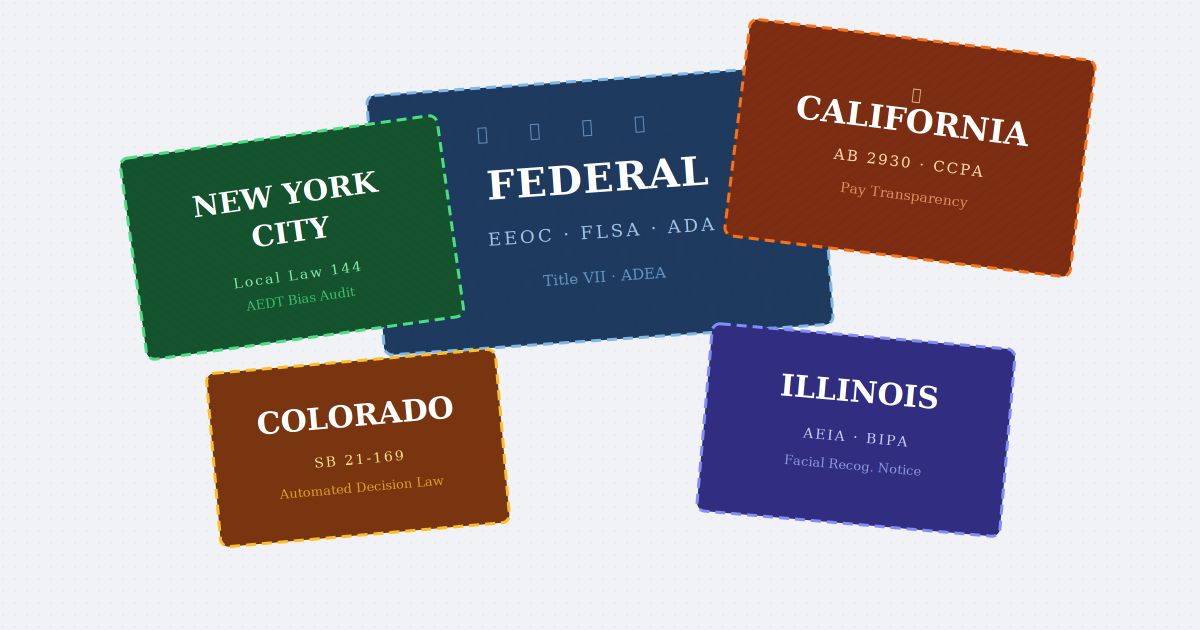
Illinois is live, Colorado lands June 30, twenty states now regulate HR data, and a federal executive order is fighting all of it. Chasing each statute is a losing game. Here's the highest-common-standard posture that holds up regardless of how the fight resolves.
Compliance