
.png)
Employment law doesn't wait for you to finish implementing your HRIS. New obligations land whether you're ready or not — and for companies between 50 and 500 employees, the compliance burden has grown meaningfully in 2026. Pay transparency requirements have spread to new jurisdictions. Leave entitlements have expanded. AI hiring regulations have moved from proposed rules to enforcement. And if you're operating across multiple provinces or states, the patchwork has gotten patchier.
This isn't a legal memo. It's a practical checklist for HR and ops leaders who need to know what changed, what it means for day-to-day operations, and what your HR system should be doing to help you stay current. When in doubt on any specific legal question, talk to employment counsel in your jurisdiction — the details matter and they vary.
Pay transparency requirements have become the most operationally significant employment law shift of the past two years. For companies operating in British Columbia, Prince Edward Island, New Brunswick, Ontario (where disclosure requirements continue to evolve), and a growing number of U.S. states including California, Colorado, Washington, New York, and Illinois, pay range disclosure is now a legal requirement for job postings — not a culture choice.
The practical compliance items here are straightforward but easy to get wrong:
Job posting audit. Every external job posting — including those on LinkedIn, Indeed, and your own career page — needs a visible pay range that reflects what you'll actually pay. Posting "$1 to $500,000" to satisfy the letter of the law while obscuring intent has drawn regulatory attention in several jurisdictions. Make sure your ranges are real and defensible.
Internal equity exposure. Pay transparency requirements don't just affect hiring — they expose internal compression and equity gaps that HR may have known about but deprioritized. If you're publishing ranges externally, current employees can and will compare. Proactively auditing and addressing compression before publishing is the right sequence.
HRIS field requirements. Your HR system needs clean, structured compensation data to support pay transparency at scale. If salary bands live in a spreadsheet somewhere, this is the year to move them into a system with proper field architecture. Rippling's compensation module and custom fields support band-level documentation that connects to job codes — which matters when you're managing postings across multiple locations with different disclosure thresholds.
Leave law has been the quieter but equally consequential area of change. Several jurisdictions added or expanded entitlements in 2025 and 2026 that are now in effect:
Bereavement leave expansions. Multiple Canadian provinces and several U.S. states have expanded the definition of qualifying relationships for paid bereavement leave — including pregnancy loss, miscarriage, and in some cases the loss of a pet (yes, seriously, in limited U.S. jurisdictions). Review your bereavement policy against current statutory minimums in every jurisdiction where you employ people.
Sick leave entitlements. Paid sick leave mandates continue to expand at the municipal and state level in the U.S. Cities including Chicago, Minneapolis, and Portland have specific paid sick leave floors that exceed state requirements. If you're operating in multiple U.S. cities, you need to track at the city level, not just the state level.
Reproductive health and family leave. Several U.S. states have enacted new or expanded protections around reproductive health decisions, including leave and accommodation requirements. These are jurisdiction-specific and the details matter — this is one area to review with employment counsel rather than rely on a generalized policy.
What your HRIS needs to do here. Your leave management system needs to be configured with the correct entitlements for each employee's work location — not their home address or their manager's location. Rippling's leave policies can be set at the work location level, which is the right architecture. If you're using a flat "everyone gets X days" policy across all jurisdictions, you have compliance exposure that a location-based configuration would eliminate.
The regulatory environment around AI-assisted hiring tools has shifted from "guidance documents and proposed rules" to active enforcement in several jurisdictions. If you're using any automated tool in your hiring process — including resume screening software, video interview analysis, or scoring algorithms — you need to know what your obligations are.
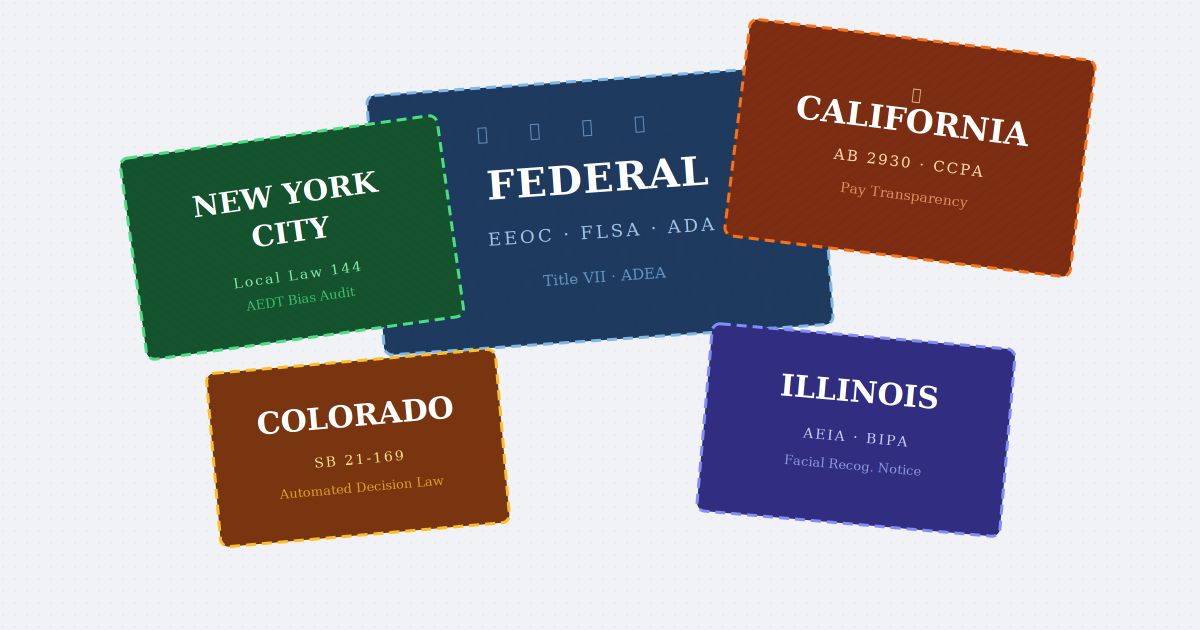
Jurisdictions with active requirements. New York City's Local Law 144 requires employers using automated employment decision tools to conduct bias audits and provide notice to candidates. Illinois has expanded its AI Video Interview Act. The EU AI Act, now in effect for high-risk AI systems, applies to companies with EU-based employees regardless of where the company is headquartered.
What to audit now. Get a complete list of every tool in your hiring process that uses any form of algorithmic scoring or filtering. For each tool, determine: (1) whether you've received a bias audit from the vendor, (2) whether candidates are notified that the tool is being used, and (3) whether you have a process for candidates to request human review. These aren't optional in covered jurisdictions.
Documentation requirements. In several jurisdictions, you're required to retain records of how automated tools were used in hiring decisions and for how long candidates were evaluated by AI versus human reviewers. If your ATS doesn't log this natively, you need a documentation process. Our earlier piece on the AI hiring compliance patchwork goes deeper on the federal-state dynamics.
Termination law is one of the areas where mid-market companies most frequently get caught by details they assumed were standard across jurisdictions but aren't.
Notice period minimums. In Canada, both federal and provincial notice minimums apply — and they're calculated differently. Employees with longer tenure can have notice entitlements that are far longer than what most U.S.-trained HR professionals expect. The Ontario Employment Standards Act, for example, sets out both minimum notice and pay-in-lieu requirements that stack with common law reasonable notice, which is a separate obligation entirely.
Final pay timing requirements. In the United States, final pay timing requirements vary dramatically by state. California requires final pay on the last day of employment for involuntary terminations. Other states allow the next regular pay cycle. Processing terminations centrally without accounting for this state-by-state variation is a wage-and-hour compliance risk.
Benefit continuation obligations. Know your COBRA obligations in the U.S. and equivalent continuation requirements in Canadian provinces. These are administrative requirements with hard deadlines — and they need to be in your offboarding workflow, not managed ad hoc by whoever happens to process the termination that day.
Compliance is a data and process problem as much as a legal one. Here's what your HR system should be configured to handle:
Work location as the compliance anchor. Every compliance rule — leave entitlements, final pay timing, posting requirements — should flow from the employee's work location, not their home address or your HQ address. If your HRIS doesn't have a clean, mandatory work location field that drives policy application, fix that first.
Policy versioning with effective dates. When a jurisdiction changes a leave entitlement or pay transparency requirement, you need to update the policy in your HRIS and have it apply correctly from the right effective date. Systems that don't support policy versioning force you to manage this manually — which is how things get missed.
Audit trail for hiring decisions. If you're using automated tools in hiring, your HRIS and ATS together need to provide a defensible record of how each hiring decision was made and what role any automated tool played. This is becoming a standard compliance requirement, not a nice-to-have.
Automated compliance notifications. Rippling's compliance alerts and managed services layer can surface changes in statutory requirements and flag when your current configuration may need updating. This doesn't replace employment counsel, but it does mean you're not relying on a team member manually tracking every regulatory update in every jurisdiction where you operate.
If you're a 50–500 person company operating across multiple jurisdictions, here's a reasonable 90-day compliance review sequence:
Month 1: Audit your job postings for pay transparency compliance in all jurisdictions where you're actively hiring. Confirm your compensation bands are documented in your HRIS, not just a spreadsheet. Review your leave policies against current statutory minimums by work location.
Month 2: Audit your hiring tech stack for AI-assisted tools and confirm your vendor bias audit status. Review your termination process for final pay timing compliance by state/province. Confirm your offboarding workflow includes COBRA/benefit continuation triggers with correct notice windows.
Month 3: Run a work location audit — confirm every employee's work location field is accurate in your HRIS and driving the correct policy set. Review with employment counsel for any jurisdictions where you're unsure. Document what you found and what you changed.
Employment law compliance in 2026 requires more jurisdictional precision than most mid-market HR systems were originally configured to deliver. The companies that stay current aren't necessarily the ones with the biggest legal budgets — they're the ones who've designed their HR operations infrastructure to make compliance systematic rather than reactive.
If you want to pressure-test your current Rippling configuration against your compliance obligations, reach out to thePeopleStack team. We do this kind of configuration and compliance review regularly, and we know where the gaps tend to hide.



December 24, 2025
Career
It's 2026, and career ladders are breaking down as flatter organizations, faster skill change, and AI reduce traditional promotion paths. Research shows high performers now grow by expanding scope, building in-demand skills, moving laterally, and earning trust through outcomes—not by waiting for titles. Employees must manage careers as portfolios of skills and impact, while PeopleOps and HR must redefine growth around scope and mobility, enable managers in leaner orgs, and ensure fair access to opportunity or risk losing top talent.
Career


November 28, 2024
Compliance
Upcoming 2025 employment law changes in the U.S. and Canada will significantly impact businesses, but Rippling’s automated compliance tools and robust HR features can help organizations stay ahead and confidently adapt to evolving regulations.
Compliance

July 11, 2026
Compliance
Illinois is live, Colorado lands June 30, twenty states now regulate HR data, and a federal executive order is fighting all of it. Chasing each statute is a losing game. Here's the highest-common-standard posture that holds up regardless of how the fight resolves.
Compliance