
.png)
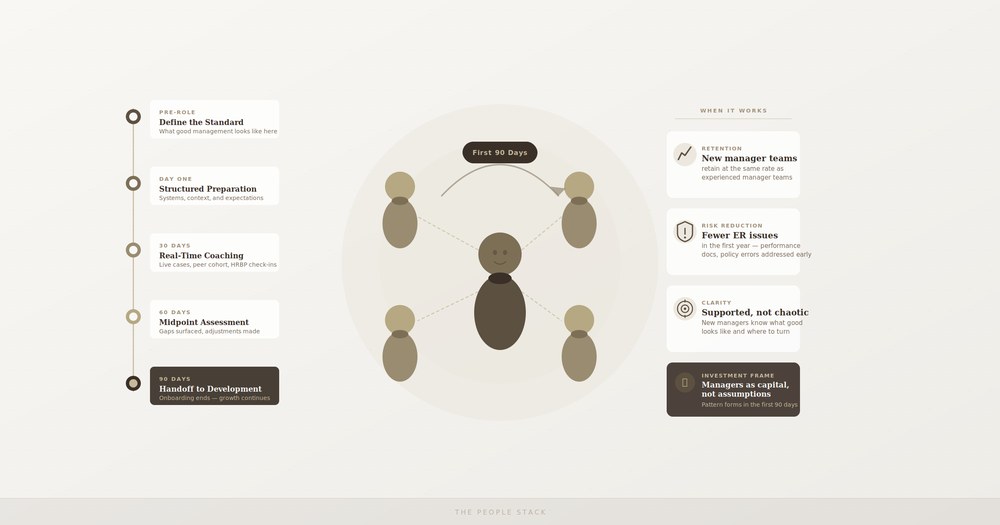
Most companies put serious effort into onboarding new employees. Almost none of them put equivalent effort into onboarding new managers. The assumption is that if someone was a strong individual contributor, they'll figure out management — and that a few introductory conversations, a policy handbook, and some good intentions will carry them the rest of the way. What actually happens is that new managers spend their first three to six months operating on instinct, discovering their gaps the hard way, and absorbing coaching they should have received before they had direct reports instead of after they'd already made avoidable mistakes.
The cost of that gap is real and underestimated. Manager quality is the single strongest predictor of employee engagement and retention in the research literature, consistently explaining more variance than compensation, role fit, or organizational culture. A new manager who struggles creates a cascading impact — on their team's performance, on the organization's ability to retain the people they were managing, and on the company's capacity to grow without leadership becoming the constraint. This post covers what a serious manager onboarding program looks like, why most programs fail, and how to build one that actually changes behavior rather than checking a box.
The failure mode is consistent across companies of different sizes and industries. Manager onboarding, where it exists at all, tends to look like: a welcome conversation with an HR business partner, a stack of resources to read, maybe a one-day workshop on giving feedback or managing performance. The new manager completes these activities and is then left to manage.
The problem isn't the content. It's the timing, the format, and the absence of any accountability loop. Learning about difficult conversations from a workshop happens in the abstract — and abstract knowledge doesn't transfer reliably to a real conversation with a real report about a real performance concern. Research on skill acquisition in professional settings is consistent: information transfer produces awareness, not behavior change. Behavior change requires practice, feedback, and repetition in context. A workshop is awareness infrastructure. Skill development requires something more.
The second failure mode is timing. Many organizations provide their most intensive manager development after someone has already been managing for months — in the form of a remedial coaching engagement after something has gone wrong. That's the most expensive possible delivery channel for management fundamentals. The conversation a manager didn't know how to have well in month two doesn't happen better in month eight because HR finally found a coach. It gets patched over, or it escalates, or the employee leaves, and the manager carries an unexamined pattern forward.
The third failure mode is scope. Most manager onboarding programs treat management as a set of discrete skills — giving feedback, running one-on-ones, setting goals — without addressing the identity shift that comes with moving from individual contributor to people leader. That shift is disorienting in ways that skills training doesn't address. New managers often struggle less because they don't know how to give feedback and more because they haven't fully let go of the identity of being the best individual contributor on the team. That's a psychological and relational transition that requires explicit attention, not a module in a learning management system.
The characteristics of effective managers are well-documented. Google's Project Oxygen research, which has been replicated and extended by other organizations, consistently identifies a cluster of behaviors that separate effective managers from ineffective ones: setting clear expectations and tracking progress against them, coaching for development rather than just directing work, creating psychological safety for the team to raise concerns and surface problems, removing obstacles rather than serving as a control point, and recognizing contribution specifically and promptly.
The important insight from this research is that these behaviors are learnable. Management effectiveness is less a function of personality than of learned practice — which means that a well-designed manager onboarding program can move the needle materially, and the absence of one is a genuine organizational cost, not just a nice-to-have.
The research on manager onboarding specifically finds that the window between promotion and the first 90 days is when patterns form that are hardest to change later. New managers who receive structured support in this window — clear expectations about what good looks like, regular feedback against those expectations, coaching on specific situations as they arise — develop their foundational habits in context. New managers left to figure it out on their own develop habits too, but those habits are a product of whatever happened to work in the immediate situation, not a reflection of deliberate practice.
The prerequisite for any onboarding program is a documented answer to the question: what does good management look like here? This isn't a universal competency model downloaded from a consulting firm's website — it's a specific articulation of the behaviors and outcomes your organization values, translated into terms that are observable and actionable.
That standard should cover: how managers are expected to communicate expectations to their reports, how often they meet one-on-one and what those conversations should accomplish, how they handle underperformance, how they develop people for next roles rather than just current ones, and what they're responsible for in the HR processes — performance reviews, compensation cycles, onboarding their own team members — that require their participation. Without a documented standard, there's nothing to onboard new managers to. The standard is the curriculum.
Ideally, manager preparation begins before someone has direct reports — or at minimum, before they've been in the role for more than a few weeks. The critical elements in this phase:
Expectations setting from their own manager. The new manager's direct leader should have an explicit conversation about what success looks like in the first 90 days, what decisions the new manager owns versus needs to escalate, and how performance will be assessed. This is basic management — it's also frequently skipped when the new manager is a high performer who the organization trusts to figure it out.
Introduction to the HR systems and processes they'll own. For companies running Rippling, this means walking new managers through the tools they'll use: approving time off, participating in compensation cycles, using performance management features, accessing their team's org data. A manager who doesn't know how to navigate the HRIS confidently is a manager who defers HR tasks, creates process debt, and makes errors in the systems that affect their team members' experience. The systems introduction is not optional — and integrating it into manager onboarding rather than leaving it to self-discovery pays dividends quickly. For how Rippling's workflow architecture supports this, see our post on when to hire, outsource, or automate in HR operations.
Their team context. Before a manager has their first one-on-one with each direct report, they should have read their team members' recent performance notes, understand current projects and priorities, and know the relevant history that shapes each person's situation. This preparation makes the first one-on-ones meaningfully better — and signals to the team that the manager shows up ready to learn, not just ready to assert authority.
The 90-day window is where the program does its most important work. The elements that move the needle:
Weekly check-ins with an HR business partner or people operations lead for the first 60 days. Not coaching for its own sake — specific conversations about situations the new manager is navigating in real time. A difficult one-on-one that happened yesterday. An underperformance situation they're not sure how to approach. A team conflict they've inherited. Working on real cases in real time is how skills transfer from abstract understanding to actual practice.
A peer cohort of other new managers. If your organization has enough volume to run cohort-based programming, the peer learning dynamic is significantly more valuable than solo support. New managers normalize their experience against peers at the same stage, build relationships with people who understand their current challenges, and often get the most practically useful advice from each other rather than from HR. Even in smaller organizations, connecting two new managers who started in the same quarter creates a meaningful support relationship.
Midpoint check-in at 45 days. A structured conversation between the new manager, their own leader, and HR — not a performance review, but an explicit check on: how are they doing against the manager standard? Where are the gaps? What support do they need in the second half of the 90 days? The conversation is more valuable for what it surfaces than for what it concludes.
Explicit feedback from their own team at 60–90 days. Not a full 360 review — that comes later. A lightweight, structured pulse on how the team is experiencing the new manager's onboarding. The data goes to the new manager and their leader simultaneously, with a coaching conversation facilitated by HR. Getting direct reports' perspective early and explicitly is the fastest way to surface the blind spots that new managers almost universally have about how they're landing.
Manager onboarding ends at 90 days; manager development doesn't. The handoff from onboarding to ongoing development should be explicit rather than assumed. By the end of the 90-day window, every new manager should have: a documented development plan with 2–3 focus areas for the next six months, a clear understanding of how their performance as a manager will be assessed at their next formal review cycle, and an established rhythm of ongoing manager development — whether that's a quarterly manager forum, a peer coaching structure, or continued HRBP support.
The organizations that see the best results from manager development treat it as an ongoing investment rather than an initial orientation. The transition out of onboarding is the beginning of that investment, not the conclusion of it.
The operational side of manager onboarding — making sure new managers have the right system access, complete required acknowledgments, and are correctly configured in the HRIS as a manager with direct reports — is the kind of workflow that Rippling handles natively and most companies handle inconsistently.
In a well-configured Rippling environment, the event that triggers a manager role change can automatically: update the org chart, assign the new manager to the relevant manager learning workflows, grant appropriate HRIS permissions to view their direct reports' data, enroll them in the manager onboarding checklist, and notify HR that a new manager has been provisioned. None of that requires a manual intervention — it's logic that runs because the system is configured to run it.
The practical benefit is that the onboarding program isn't dependent on anyone remembering to kick it off. The platform handles the operational trigger; the program handles the development work. For companies with significant hiring volume or rapid internal mobility, this automation is the difference between a manager onboarding program that actually runs consistently and one that runs when someone has time.
Building that workflow configuration correctly, against a clean org structure and job architecture, is part of the implementation design work we do for clients at thePeopleStack. If your Rippling environment isn't currently set up to automate manager role transitions, a Rippling HealthCheck will show you what the current configuration supports and where the gaps are.
How do you know if your manager onboarding program is actually working? A few leading indicators:
New managers who complete the program describe their first 90 days as supported rather than chaotic — and specifically, they can articulate what's expected of them and where to go when they're uncertain. This sounds basic. For most organizations without structured programs, it's not the experience new managers report.
The rate at which new managers generate employee relations issues in their first year decreases. Difficult conversations handled badly, performance documentation errors, and inconsistent policy application are the most common early-manager failure modes — and all of them are addressable through the kind of structured support described above.
The 12-month retention rate for employees who report to new managers is indistinguishable from the retention rate for employees who report to experienced managers. The research on manager quality and retention is clear: when new managers struggle, their reports leave at elevated rates. When new managers are well-supported, that effect disappears.
Manager onboarding is one of the highest-leverage investments a growing company can make in its HR function. The cost of not having a program — in management mistakes, team performance, and attrition — consistently exceeds the cost of building one, and the build doesn't require a large HR team or an expensive external vendor.
What it requires is clarity about what good management looks like in your organization, a structured first 90 days that bridges abstract knowledge and real practice, and a transition into ongoing development that treats managers as an investment rather than an assumption.
If you're building this from scratch or improving a program that isn't producing the results you'd expect, the HR function design work at thePeopleStack is built for exactly this kind of project. Get in touch and we'll help you figure out where to start.



December 24, 2025
Career
It's 2026, and career ladders are breaking down as flatter organizations, faster skill change, and AI reduce traditional promotion paths. Research shows high performers now grow by expanding scope, building in-demand skills, moving laterally, and earning trust through outcomes—not by waiting for titles. Employees must manage careers as portfolios of skills and impact, while PeopleOps and HR must redefine growth around scope and mobility, enable managers in leaner orgs, and ensure fair access to opportunity or risk losing top talent.
Career


November 28, 2024
Compliance
Upcoming 2025 employment law changes in the U.S. and Canada will significantly impact businesses, but Rippling’s automated compliance tools and robust HR features can help organizations stay ahead and confidently adapt to evolving regulations.
Compliance

July 11, 2026
Compliance
Illinois is live, Colorado lands June 30, twenty states now regulate HR data, and a federal executive order is fighting all of it. Chasing each statute is a losing game. Here's the highest-common-standard posture that holds up regardless of how the fight resolves.
Compliance