
.png)

For decades, “career growth” meant a familiar climb: analyst to senior analyst, manager to senior manager, director to VP—one rung at a time. In 2026, that model is breaking down in a way that’s structural, not cyclical. Organizations are flattening, management layers are being redesigned, and AI is changing what “seniority” even means. The result is a new reality: high performers still grow, but fewer grow by moving “up.” They grow by expanding scope, building portable skills, and moving laterally across problems that matter.
This shift isn’t anecdotal. Research and market signals show companies are experimenting with flatter structures and reassessing the role of middle management (Deloitte – Future of the Middle Manager). At the same time, employers expect rapid skills change across roles through 2030 (WEF – Future of Jobs Report 2025). And talent leaders are increasingly turning “recruiting inward” to close skills gaps—yet internal mobility isn’t rising as fast as investment would suggest (Gartner – Talent Management Trends for 2026).
So what does career growth look like now—especially for ambitious people who want to keep advancing without waiting for a title vacancy?
This article lays out the 2026 playbook for employees, managers, and PeopleOps leaders.
When organizations remove layers, they reduce the number of formal leadership seats available—often unintentionally turning promotions into a scarcity event. Deloitte notes that flatter firms can centralize decision-making at the top, sometimes creating the opposite of the agility companies want (Deloitte – Future of the Middle Manager). This matters because fewer layers = fewer title-based steps.
Many “new jobs” are not net-new jobs—they’re existing roles with significantly upgraded skill expectations. SHRM’s recent reporting highlights that organizations increasingly need new skills even for existing positions and anticipate higher investment in rapid upskilling (SHRM – Real-Time Upskilling). That means growth is often less about your next title and more about your next capability bundle.
AI can raise the baseline performance of novice workers by augmenting tasks, which can reduce the advantage that used to come from years of accumulated routine knowledge. Microsoft’s research points to AI’s impact on career decisions and mobility patterns (Microsoft Research – New Future of Work Report 2025 PDF). Translation: seniority still matters, but differently—the premium shifts to judgment, domain context, stakeholder trust, and ownership of outcomes.
Organizations want internal movement because it closes skills gaps and supports engagement, but the systems and behaviors required are non-trivial. Gartner has explicitly called out that companies are investing in internal mobility while internal mobility rates remain flat (Gartner – Talent Management Trends for 2026).
In practice, high performers progress through four growth paths, often in combination:
You keep a similar title, but your accountability expands:
This is increasingly how companies operate when promotions are limited: they expand scope, then later normalize titles if/when structure catches up.
You build skills that unlock more valuable work:
The macro signal here is consistent: skills requirements are shifting quickly across job families (WEF – Future of Jobs Report 2025).
You move sideways into roles that broaden your range:
This “career lattice” approach is increasingly necessary when the ladder is blocked. It is also how you build resilience: your value is not tied to one function.
You become the “go-to” person for a category of outcomes:
In flatter orgs, reputation and trust often travel faster than titles.
If you are an employee aiming to grow faster than the org chart, focus on these moves.
A promotion is an outcome. A bigger problem is an input. The most effective growth conversation sounds like:
This reframes growth as value creation, not entitlement.
In 2026, the most compelling professionals can point to:
This aligns with the broader shift toward skills-based work models (Deloitte – The Skills-Based Organization).
Waiting until you’re “fully qualified” can stall your career. Gartner research suggests employees moved or hired based on promise can outperform those hired based on demonstrated proficiency, highlighting the upside of potential-based placement (Gartner – Closing Skills Gaps at Scale).
Practical application: seek roles where you meet 60–70% of requirements but have strong learning velocity and proven execution.
A lateral move that increases your scope, skills, and network is often a faster track to seniority than waiting for the “next rung.” If you’re not sure, evaluate the move with three questions:
If two of three are “yes,” it’s probably growth.
In 2026, titles matter less than impact language:
High performers translate their work into outcomes leaders care about.
If the ladder is breaking, HR must replace it with something better—or employees will create their own pathways outside the company.
Career frameworks that rely on title progression fail in flatter structures. Update your career architecture to include:
LinkedIn’s learning research emphasizes internal mobility as a key metric for career development “champions” (LinkedIn – Workplace Learning Report 2025 PDF).
Many internal mobility initiatives stall because they are built like recruiting, not like product. A real mobility engine needs:
Gartner notes the emphasis on internal mobility is rising, but execution remains challenging (Gartner – Talent Management Trends for 2026).
Mobility can improve opportunity—but it can also deepen inequality if only highly skilled or highly networked employees benefit. OECD warns that when upward mobility skews toward higher-skilled workers, job mobility can deepen wage inequality (OECD – Employment Outlook 2025).
Translate that into policy: ensure mobility pathways are accessible, coached, and visible to more than just “favorites.”
Flatter structures increase spans of control and reduce coaching capacity. If you flatten without manager enablement, performance and development degrade. Deloitte highlights the tension: remove middle layers, and you often remove the connective tissue that develops talent (Deloitte – Future of the Middle Manager).
Minimum viable fix:
Upskilling cannot be generic in 2026. It needs to map to:
This aligns with the broader shift toward rapid, continuous upskilling investment (SHRM – Real-Time Upskilling).
In 2026, the strongest careers will look less like ladders and more like portfolios—of skills, problems solved, and trust earned. Titles still matter, but they are no longer the only (or even the primary) proof of growth.
If you want your best people to stay, you need to offer something better than “wait your turn.” You need visible pathways to expand scope, build skills, and move across the organization with speed and fairness.
Because high performers will keep growing either way.
The only question is whether they’ll do it with you or without you.

December 24, 2025
Career
It's 2026, and career ladders are breaking down as flatter organizations, faster skill change, and AI reduce traditional promotion paths. Research shows high performers now grow by expanding scope, building in-demand skills, moving laterally, and earning trust through outcomes—not by waiting for titles. Employees must manage careers as portfolios of skills and impact, while PeopleOps and HR must redefine growth around scope and mobility, enable managers in leaner orgs, and ensure fair access to opportunity or risk losing top talent.
Career


November 28, 2024
Compliance
Upcoming 2025 employment law changes in the U.S. and Canada will significantly impact businesses, but Rippling’s automated compliance tools and robust HR features can help organizations stay ahead and confidently adapt to evolving regulations.
Compliance

July 11, 2026
Compliance
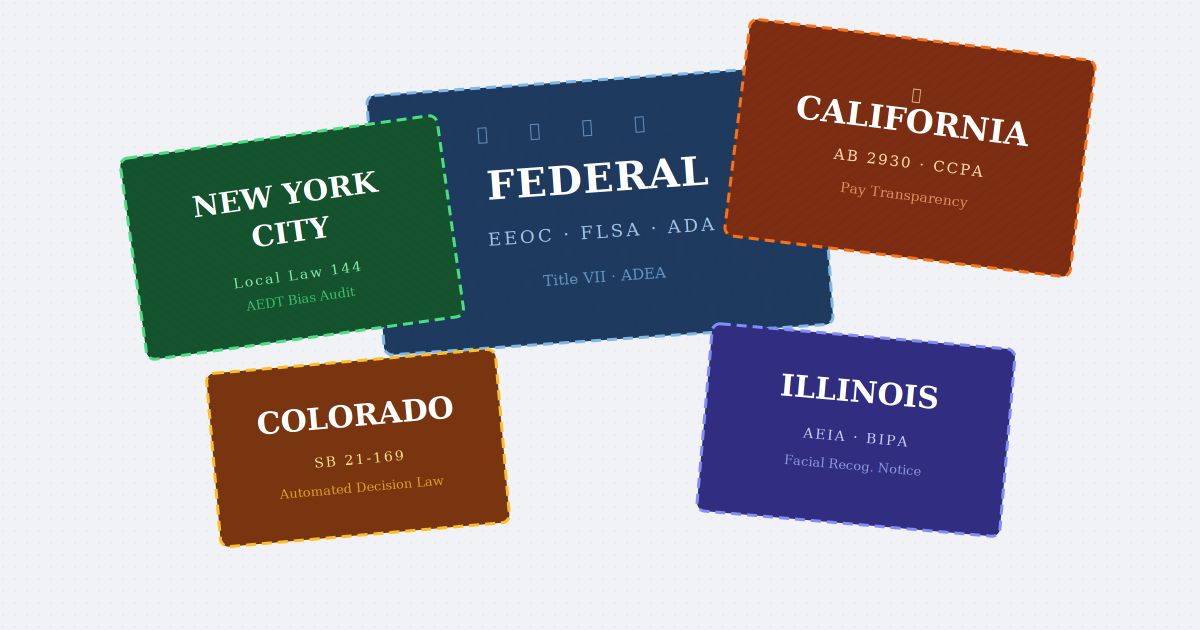
Illinois is live, Colorado lands June 30, twenty states now regulate HR data, and a federal executive order is fighting all of it. Chasing each statute is a losing game. Here's the highest-common-standard posture that holds up regardless of how the fight resolves.
Compliance
We'd like to use cookies from Google Analytics (to understand how the site is used) and Google Ads / DoubleClick (to measure our ads). They stay off unless you accept. See our Privacy Policy.
Your browser is sending a Global Privacy Control signal, so tracking is off and we won't sell or share your information.