
.png)
Something shifted in early 2026. The conversation about AI in HR stopped being about what might be possible and started being about what teams are actually running in production. The chatbots that answered FAQs? That’s not what we’re talking about anymore. AI agents — systems that don’t just respond to questions but take action, manage workflows, and operate across connected systems — have arrived in HR in a meaningful way.
This post isn’t a hype piece. It’s a practical breakdown of what AI agents are actually doing in HR right now, where they’re delivering real value, where they’re still limited, and what HR leaders, People Ops practitioners, and IT buyers should be thinking about as they evaluate their own roadmap.
The distinction matters. Most HR teams have already experimented with AI in some form — a chatbot, a resume screening feature, an analytics dashboard. But AI agents represent a qualitatively different capability.
A traditional AI tool responds. You ask it something, it returns an answer or output. An AI agent acts. It understands a goal, reasons through steps to achieve it, and executes across multiple systems — without requiring a human to manage each step.
The practical difference: a traditional AI tool can tell you which candidates in your pipeline meet certain criteria. An AI agent can source candidates, screen applications, schedule interviews with hiring managers, send personalized communications to candidates, and notify the recruiting team of bottlenecks — all as part of a single autonomous workflow.
This shift from “AI that assists” to “AI that executes” is what the market is currently racing to deliver. And it’s why analysts like Josh Bersin are describing 2026 as the most significant transformation year in HR technology in a generation.
This is where AI agent deployment is most mature, and where the ROI case is clearest. The traditional recruiting workflow — posting jobs, screening applications, coordinating schedules, collecting feedback — is time-intensive, error-prone, and highly repetitive. It’s exactly the kind of workflow AI agents were built for.
Modern recruiting agents can autonomously source candidates across job boards, internal databases, and talent networks; screen applications against custom criteria you define; schedule interviews by analyzing calendar availability on both sides; and synthesize interviewer feedback into structured summaries for the hiring team.
Rippling launched its full AI recruiting suite in early 2026, including Application Review (automated screening with transparent summaries explaining why candidates qualify or don’t), an Interview Assistant that records and transcribes interviews so interviewers can stay focused on the conversation, Smart Scheduling that eliminates the back-and-forth of finding interview times, and AI-generated job descriptions that automatically flag exclusionary language before posting. See how thePeopleStack approaches Rippling Recruiting implementations here.
Two features are worth flagging specifically: built-in bias checks that alert hiring teams if screening criteria could inadvertently filter out protected groups, and Applicant Fraud Detection (coming soon) that flags suspicious applications using signals like VPN usage and location inconsistencies. These embed compliance thinking directly into the workflow rather than treating it as an afterthought.
Across the market, PwC estimates that AI agents can reduce time spent on talent sourcing by up to 70% for hiring managers. That’s not a marginal efficiency gain — it’s a fundamental shift in how recruiting capacity scales.
HR service desks are overwhelmed. Leave requests, benefits questions, policy lookups, employment verifications, payroll inquiries — the volume of routine queries that HR teams handle is enormous, and the work is almost entirely interruptive. It pulls HR professionals away from higher-value work constantly.
AI agents are making a measurable dent here. Unlike rule-based chatbots that retrieve static FAQ responses, modern helpdesk agents access live employee data, pull context from connected systems, handle multi-step tasks, and escalate complex cases to humans with full context already assembled.
Rippling’s own deployment offers a clear case study. The company partnered with Decagon AI to replace a decision-tree-based support system with autonomous agents capable of handling Tier-1 and Tier-2 support tickets across its HR, Payroll, and IT products. The result: chat self-service rates climbed from 38% to over 50%, with resolution happening in seconds rather than hours, around the clock.
What made this work technically was the agents’ ability to pull user-specific data directly from Rippling’s systems. When an admin asks about a specific employee’s healthcare enrollment status, the agent retrieves that exact record and answers precisely — not approximately. This data-grounded specificity is what separates modern agents from earlier chatbot generations. It also directly connects to the value of thePeopleStack’s Managed Services — organizations with well-configured, clean Rippling environments get far more accurate agent responses.
Onboarding is one of the most process-dense workflows in HR. New hire paperwork, system access provisioning, policy acknowledgments, benefits enrollment, equipment setup, team introductions, training assignments — coordinating all of it across HR, IT, and Finance is a significant operational lift, especially during high-growth hiring periods.
AI agents are particularly effective here because onboarding is rule-driven, multi-step, and highly repeatable. An agent can trigger automatically on hire, provision role-appropriate system access, enroll the employee in the right benefits plan, assign relevant training modules, create accounts in connected tools, and guide the new hire through the process with a personalized experience — all without manual intervention at each step.
Rippling’s unified data model gives it a structural advantage in this area. Because HR, IT, and Finance data all live in the same platform, an onboarding workflow in Rippling can simultaneously update payroll records, provision app access through Identity & Access Management, assign the right device policy, and trigger benefits enrollment — things that would require manual coordination between three separate systems in a fragmented stack. Related: thePeopleStack’s implementation approach is designed from day one with these automated workflows in mind.
This is where AI agents create the most strategic value — and where most organizations are still in early stages.
The core capability: AI agents that continuously analyze workforce data can surface patterns that humans wouldn’t catch until they become problems. Declining engagement scores correlated with specific managers. Skill gap trajectories tied to business priorities. Teams with elevated attrition risk. Succession pipeline health. These aren’t insights that require a data scientist — they’re patterns AI can identify and flag in real time. Gartner reports that approximately 80% of HR leaders believe AI will be a significant driver of operational excellence by 2026.
The March 2026 launch of Rippling AI is directly relevant here. Rather than building a conventional analytics dashboard, Rippling took an agentic approach: the system writes code (SQL queries, report logic, formulas) to answer questions using your live data. Ask it about voluntary termination trends over six years, and instead of hours of manual analysis, you get a precise, auditable answer with the underlying report attached.
The key differentiators Rippling highlights: answers are deterministic (not guesses), auditable (you can see the query it ran), permissions-aware (a manager sees their team; an HR admin sees more), and grounded in your specific organizational data — not generic benchmarks. References like “my team” or “last quarter” resolve against your actual records, not approximations.
This is a fundamentally different relationship with workforce data than most HR teams have today. The question isn’t whether your team can answer a question — it’s whether they can answer it in seconds instead of days. It also underscores the value of a Rippling HealthCheck before leaning into AI features — clean data in means accurate intelligence out.
Compliance is a persistent, low-visibility problem in HR. Requirements change, edge cases accumulate, and the cost of failure is asymmetric — most compliance lapses go unnoticed until they become material issues.
AI agents are well-suited to continuous compliance monitoring precisely because they don’t get tired, don’t miss patterns in volume, and can be configured to flag anomalies proactively. In practice, this looks like agents that monitor time and attendance records against labor regulations, flag compensation decisions that may conflict with pay equity requirements, track certification and licensing expiration dates, and audit access permissions against policy.
For global organizations, this is particularly valuable. Rippling’s AI operates across its global payroll infrastructure spanning over 185 countries — meaning compliance monitoring can be applied at scale without a team of regional specialists manually checking each jurisdiction. For teams managing international workforces, this connects directly with thePeopleStack’s Global Payroll and Employer of Record solutions.
Honest assessment requires acknowledging what isn’t working yet.
Multi-agent orchestration — the idea of deploying many specialized agents that coordinate seamlessly to handle end-to-end workflows — is architecturally promising but operationally immature for most companies. The challenge isn’t any single agent; it’s stitching them together across systems, business rules, and data models without creating new points of failure. Josh Bersin describes this as “the war for enterprise agents” — the big battle isn’t which agent to buy, it’s how to stitch them together.
“Superagents” that manage the full employee lifecycle autonomously are still more roadmap than reality. Vendors are building toward this, and the Josh Bersin Company’s research has identified over 100 potential HR agent applications — but the path from 100 potential applications to a coherent, deployed system that works reliably in your specific organizational context is not short.
Predictive attrition models are only as good as the data feeding them. If your HRIS has inconsistent data hygiene, your engagement survey response rates are low, or your performance data is sparse, the predictive signal is weak. AI doesn’t fix bad data — it amplifies it.
Change management is still the bottleneck. Deployment is the easy part. Getting HR teams, managers, and employees to trust, adopt, and actually use AI-powered workflows is where most implementations stall. This isn’t an AI problem — it’s an organizational problem that AI can’t solve on its own.
For thePeopleStack clients and anyone evaluating Rippling as a platform, the March 2026 launch of Rippling AI is significant — but it requires some nuance.
Rippling AI is genuinely differentiated from most enterprise AI products in one key way: it’s not a layer on top of your data. It’s integrated directly into Rippling’s live data model, business logic, and permissions infrastructure. When it acts, it acts through the same approval workflows and permission controls that govern everything else in the system. No action is taken without human confirmation. This “AI shows its work” architecture — where you can see and verify the query or logic it used — addresses a real concern about auditability that most enterprise AI products haven’t resolved.
What this means practically: if you’ve invested in building a clean, well-configured Rippling environment — consistent job titles, accurate department hierarchies, clean payroll data — Rippling AI will return far more useful outputs than if your data model is messy. The platform amplifies good data hygiene. It doesn’t compensate for poor data hygiene.
This is where partner-led implementation pays dividends over time. The organizations getting the most from Rippling AI today are the ones whose Rippling environments were built with long-term data integrity in mind — not just deployed to go live. If you’re not confident in your current Rippling configuration, a HealthCheck from thePeopleStack is the right starting point before investing heavily in AI features.
If you’re an HR leader trying to prioritize where to actually deploy AI agents, here’s a practical framework:
Start with high-volume, rule-driven workflows. Recruiting screening, helpdesk tickets, onboarding checklists, compliance monitoring — these are the right first targets. They’re repetitive, they have clear success criteria, and they free up your team for work that actually requires human judgment. See our full Rippling modules overview for where automation applies across the platform.
Audit your data quality before you deploy. AI agents are only as reliable as the data they run on. Before you invest in AI-driven analytics or predictive workforce planning, assess whether your underlying Rippling data is accurate and consistent enough to trust. This is exactly what our HealthCheck service is designed to uncover.
Design for human-in-the-loop. The best AI agent deployments in HR right now keep humans in the approval chain for consequential decisions. Use agents to prepare, surface, and recommend — but maintain human oversight for anything that affects compensation, termination, promotion, or performance evaluation.
Don’t conflate AI features with AI strategy. Turning on the AI features your platform ships doesn’t constitute an AI strategy. The organizations seeing real returns are those that have explicitly redesigned workflows around AI capabilities — not just bolted AI onto existing processes. thePeopleStack’s Rippling consulting and Managed Services teams help clients do exactly this.
AI agents in HR are past the proof-of-concept stage. The use cases that work — recruiting automation, helpdesk deflection, onboarding coordination, data-grounded analytics — are working now, in production, at companies of meaningful scale.
The hype that surrounds this space is real, but so is the signal. The gap between organizations that are actively deploying and those waiting for the technology to “mature” is already widening. The technology is mature enough. The question is whether your data, your workflows, and your team are ready to use it well.
If you’re running on Rippling and want to think through where AI actually fits in your current environment — what’s worth turning on now versus what needs groundwork first — that’s exactly the kind of conversation thePeopleStack has every day. Reach out here.



December 24, 2025
Career
It's 2026, and career ladders are breaking down as flatter organizations, faster skill change, and AI reduce traditional promotion paths. Research shows high performers now grow by expanding scope, building in-demand skills, moving laterally, and earning trust through outcomes—not by waiting for titles. Employees must manage careers as portfolios of skills and impact, while PeopleOps and HR must redefine growth around scope and mobility, enable managers in leaner orgs, and ensure fair access to opportunity or risk losing top talent.
Career


November 28, 2024
Compliance
Upcoming 2025 employment law changes in the U.S. and Canada will significantly impact businesses, but Rippling’s automated compliance tools and robust HR features can help organizations stay ahead and confidently adapt to evolving regulations.
Compliance
July 11, 2026
Compliance
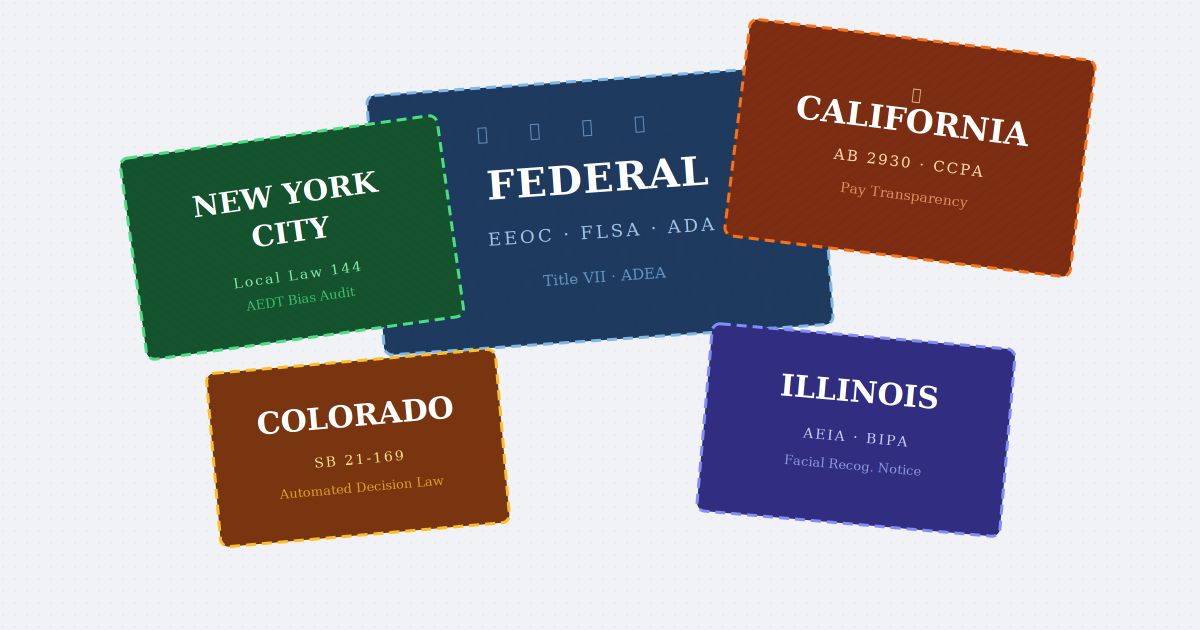
Illinois is live, Colorado lands June 30, twenty states now regulate HR data, and a federal executive order is fighting all of it. Chasing each statute is a losing game. Here's the highest-common-standard posture that holds up regardless of how the fight resolves.
Compliance
We'd like to use cookies from Google Analytics (to understand how the site is used) and Google Ads / DoubleClick (to measure our ads). They stay off unless you accept. See our Privacy Policy.
Your browser is sending a Global Privacy Control signal, so tracking is off and we won't sell or share your information.