
.png)
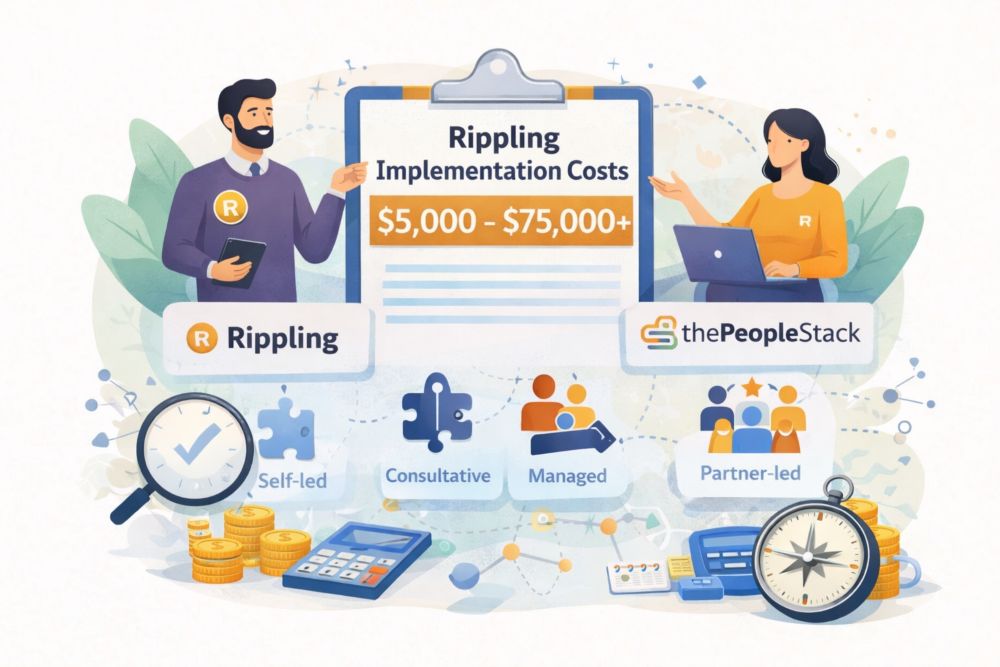
Rippling’s software pricing is modular, but implementation cost is where many buyers get surprised. The software itself may start with an entry point as low as $8 per employee per month for core HR functionality, while Payroll starts at $35 per month plus a per-employee fee. But those subscription numbers are only one part of the budget. Rippling itself makes clear that pricing is customized based on the services and modules you choose, and its implementation approach varies depending on how much support you need. (rippling.com)
What’s often overlooked is that Rippling offers multiple implementation models, each with very different cost and risk profiles:
Choosing between these—and deciding whether to work directly with Rippling or a certified partner like thePeopleStack—is one of the biggest drivers of total implementation cost.
For most companies, a Rippling implementation typically falls into one of these ranges:
These ranges align with broader HRIS implementation benchmarks, which generally fall between $3,000 and $75,000+ depending on scope, integrations, and data complexity. (outsail.co)
Rippling’s flexibility is a major strength—but it also creates confusion. The same platform can be implemented in completely different ways depending on how much ownership you take on.
This is the lowest upfront cost option.
Best for:
Reality:
This is where many implementations struggle. Without a dedicated system owner, projects stall or get partially configured—leading to “implementation drift.”
This aligns with broader HR tech guidance from Society for Human Resource Management, which warns that underestimating setup effort and internal ownership is one of the primary causes of failed or underperforming HR system implementations. (shrm.org)
This is Rippling’s middle-ground model.
Tradeoff:
You save on services, but take on significant internal workload across HR, IT, and Finance.
Here, Rippling takes a more active role.
Best for:
This is Rippling’s premium tier.
Rippling positions its implementation approach as configurable to customer needs, particularly for organizations with more complex requirements around integrations, workflows, and compliance. (rippling.com)
Rippling’s implementation models are strong—but they are still fundamentally vendor-led.
A certified partner like thePeopleStack operates differently:
focused on your operating model, not just platform deployment.
Rippling-led implementations:
thePeopleStack:
👉 https://www.thepeoplestack.co/
Many HRIS implementations start HR-first.
In reality, the hardest problems are:
This is where partner-led implementations tend to deliver more durable outcomes.
Related reading:
👉 https://www.thepeoplestack.co/post/rippling-feature-deep-dive-for-2026-planning-what-shipped-recently-and-why-it-matters
Where Rippling offers structured tiers, thePeopleStack typically supports:
For simpler deployments, a phased approach like a QuickStart implementation can reduce both cost and risk:
👉 https://www.thepeoplestack.co/services/quickstart
Most implementations optimize for go-live.
But real complexity shows up after:
This is where many companies require:
thePeopleStack’s managed services and fractional HR offerings are designed for this phase:
👉 https://www.thepeoplestack.co/services/managed-services
👉 https://www.thepeoplestack.co/services/fractional-hr
A practical way to think about cost:
ModelUpfront CostInternal EffortRisk of ReworkSelf-ledLowestVery HighVery HighConsultativeLow–ModerateHighModerateManagedModerate–HighModerateLowPartner-led (thePeopleStack)HigherLowLowest
This pattern is consistent across HRIS implementations:
Even within the same implementation model, cost varies based on six core factors.
Rippling’s pricing scales with modules—HR, Payroll, IT, Spend, and global capabilities. A 100-person company using multiple modules may fall in the $15–$25 PEPM range, while more complex deployments can exceed $30–$50+ PEPM. (rippling.com)
More modules = more configuration work.
Payroll is the biggest cost driver.
Complexity increases with:
Payroll industry benchmarks confirm that pricing and complexity increase significantly with these factors. (forbes.com)
For payroll-heavy environments, dedicated support is often required:
👉 https://www.thepeoplestack.co/products/payroll
Data issues are one of the biggest hidden costs.
HRIS implementation fees typically include:
But messy data (duplicates, missing fields, inconsistent structures) adds significant effort.
This is a common source of budget overruns across HR system implementations. (outsail.co)
Connecting Rippling to:
…adds real cost.
Custom API work, connectors, and maintenance are often under-scoped early in projects. (outsail.co)
For more complex environments, this typically falls into development and integration work:
👉 https://www.thepeoplestack.co/services/development
Rippling’s power comes from its unified data model—but that requires careful design:
Rippling itself emphasizes configuration around policies, workflows, and edge cases as a core part of implementation. (rippling.com)
A technically complete implementation can still fail if users don’t adopt it.
Implementation typically includes:
But many organizations underestimate this effort.
Industry guidance consistently includes training and go-live support as core cost components. (outsail.co)
The cheapest Rippling implementation is rarely the least expensive outcome.
A poorly executed deployment creates:
Rippling gives you flexibility in how you implement—but that flexibility shifts responsibility onto you to choose the right model.
Are you buying software, or are you building an operating system for your company?
If it’s the latter, implementation cost isn’t just about price.
It’s about getting the system right the first time.



December 24, 2025
Career
It's 2026, and career ladders are breaking down as flatter organizations, faster skill change, and AI reduce traditional promotion paths. Research shows high performers now grow by expanding scope, building in-demand skills, moving laterally, and earning trust through outcomes—not by waiting for titles. Employees must manage careers as portfolios of skills and impact, while PeopleOps and HR must redefine growth around scope and mobility, enable managers in leaner orgs, and ensure fair access to opportunity or risk losing top talent.
Career


November 28, 2024
Compliance
Upcoming 2025 employment law changes in the U.S. and Canada will significantly impact businesses, but Rippling’s automated compliance tools and robust HR features can help organizations stay ahead and confidently adapt to evolving regulations.
Compliance


July 11, 2026
Compliance
Illinois is live, Colorado lands June 30, twenty states now regulate HR data, and a federal executive order is fighting all of it. Chasing each statute is a losing game. Here's the highest-common-standard posture that holds up regardless of how the fight resolves.
Compliance