
.png)
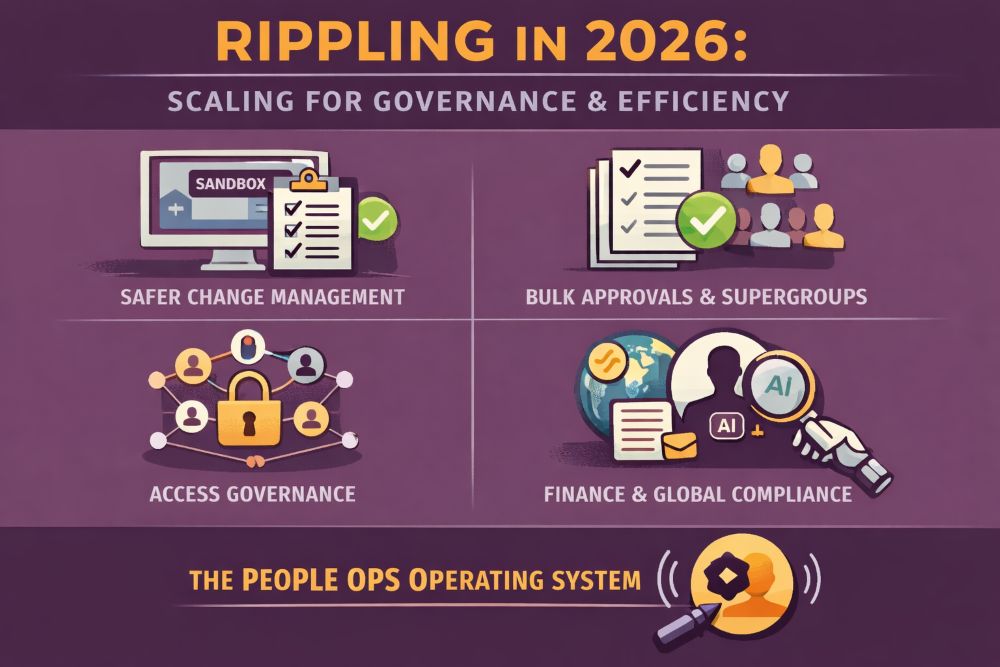
Rippling’s advantage has never been a single feature. Its power comes from how identity, policy, permissions, payroll, devices, spend, and integrations all operate on a shared employee data model.
What changed heading into 2026 is not that Rippling introduced workflows, automation, or analytics. Those primitives already existed. What changed is that Rippling spent late 2025 hardening the platform around the real failure points that emerge once organizations scale:
This article examines Rippling’s Aug–Dec 2025 releases through a single lens:
How do these changes alter how Rippling should be implemented, governed, and operated in 2026?
Rippling introduced a Sandbox environment, allowing admins to test workflows, permissions, onboarding flows, and configuration changes before deploying them to production.
Eliminate risks when launching changes with Sandbox
Most serious Rippling incidents are not software failures. They are process failures:
Sandbox enables something Rippling environments historically lacked: change discipline. It allows release management practices—test, validate, publish—without risking production stability.
This aligns with where HR and PeopleOps are heading in 2026: more automation and AI, with governance and guardrails as the limiting factor.
SHRM: Top HR Trends for 2026
For organizations running Rippling at scale, Sandbox should be standard for:
Further reading: How to Nail Your Rippling Implementation: Notes from the Field
December addressed two scaling bottlenecks:
Once organizations pass a few hundred employees, friction rarely comes from missing features. It comes from throughput:
These releases reduce operational drag and make it feasible to keep access and approvals clean at scale—especially when headcount growth outpaces admin capacity.
This shift mirrors broader 2026 dynamics: cost pressure and AI adoption are pushing HR and Talent teams to increase output without adding operators.
Gartner: Top Talent Acquisition Trends for 2026
Further reading: Managed Services on the Rippling Platform
The strategic shift is not simply automation—it is accountability. Rippling’s approach keeps:
This reflects the dominant HR position heading into 2026: AI should accelerate recruiters while preserving transparency, auditability, and human judgment.
Gartner: AI in HR
In practice, AI Application Review succeeds or fails based on foundations:
Further reading: How to Nail Your Rippling Implementation: Notes from the Field
In modern organizations, HR events are security events. These updates tighten the relationship between employee lifecycle and access lifecycle through:
Further reading:
December focused on reducing friction for finance teams:
Finance adoption hinges on day-to-day operability:
These improvements align with broader business pressures around cost control, transparency, and efficiency.
Deloitte Human Capital Trends
Further reading:
Rippling’s late-2025 releases emphasize jurisdiction-specific depth rather than surface-level coverage:
For 2026 planning, “global” increasingly means locally correct and auditable, not merely supported.
Further reading:
Rippling’s late-2025 releases are not flashy. They’re foundational.
They signal a platform optimizing for:
Those pressures define PeopleOps, HR, Finance, and IT leadership in 2026. The organizations that benefit most from Rippling will not be the ones that enable the most features—but the ones that adopt a disciplined operating model around them.
That is the difference between using Rippling and running people operations on Rippling.



December 24, 2025
Career
It's 2026, and career ladders are breaking down as flatter organizations, faster skill change, and AI reduce traditional promotion paths. Research shows high performers now grow by expanding scope, building in-demand skills, moving laterally, and earning trust through outcomes—not by waiting for titles. Employees must manage careers as portfolios of skills and impact, while PeopleOps and HR must redefine growth around scope and mobility, enable managers in leaner orgs, and ensure fair access to opportunity or risk losing top talent.
Career


November 28, 2024
Compliance
Upcoming 2025 employment law changes in the U.S. and Canada will significantly impact businesses, but Rippling’s automated compliance tools and robust HR features can help organizations stay ahead and confidently adapt to evolving regulations.
Compliance


July 11, 2026
Compliance
Illinois is live, Colorado lands June 30, twenty states now regulate HR data, and a federal executive order is fighting all of it. Chasing each statute is a losing game. Here's the highest-common-standard posture that holds up regardless of how the fight resolves.
Compliance