
.png)
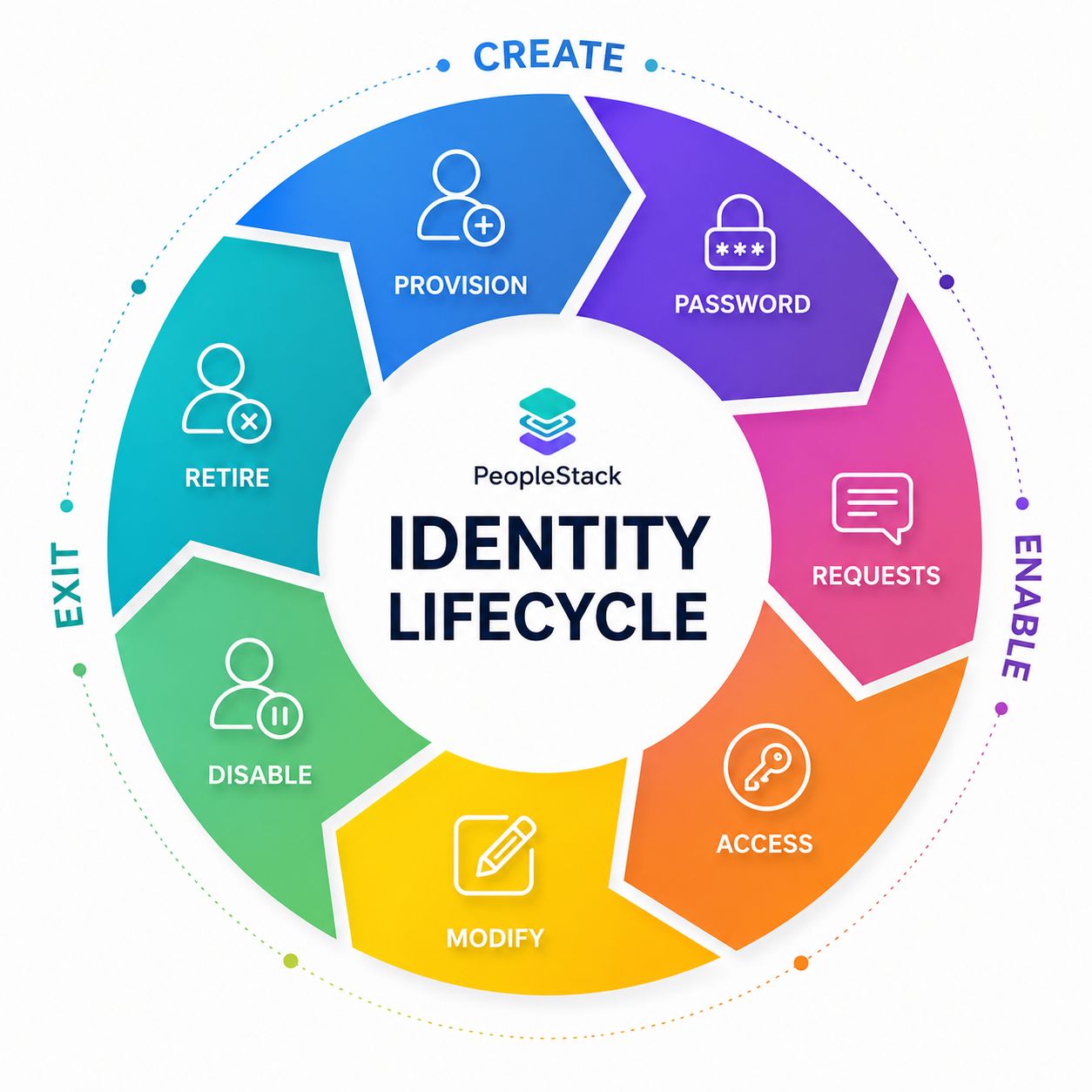
Identity lifecycle management is a term that lives mostly in security conference talks and vendor white papers. For most HR practitioners, it sounds like an IT problem — access controls, directory services, something the security team handles. That framing is wrong, and the cost of it is real. The trigger for nearly every identity event in a company's environment — a new identity created, an access grant made, a privilege elevated, an account terminated — originates in HR. The hire, the role change, the leave, the transfer, the departure: these are HR events. The identity outcomes they drive are IT security events. The two functions share the same operational thread, and when they don't act like it, the seam between them is exactly where access risk concentrates.
This post explains what identity lifecycle management actually is, why HR owns the trigger for most of it, and how a well-configured Rippling environment makes the connection between HR events and identity events operational rather than aspirational.
Identity lifecycle management (ILM) is the practice of managing digital identities — user accounts, access rights, and privileges — across their full lifecycle: creation, modification, and termination. The framework that most security practitioners use to describe this lifecycle is "joiner, mover, leaver" (JML):
Joiner: A new employee or contractor joins the organization. An identity is created, accounts are provisioned in relevant systems, access is granted based on role and scope. Done correctly, the new person has exactly the access they need on day one — not more, not less.
Mover: An existing employee changes role, department, location, or employment type. Their access profile should update to reflect the new scope — granting access required for the new role, removing access that no longer applies. This is the most frequently neglected part of the JML framework, which is why organizations accumulate "access debt" — employees whose historical access reflects a career history in the company rather than their current responsibilities.
Leaver: An employee or contractor departs. All accounts must be disabled and eventually deleted. Devices must be recovered. Active sessions must be revoked. Credentials must be rotated for any shared access the individual held. The completeness and speed of this step determines whether the exit is a security event or a security incident.
The definition sounds operational, but the implications are regulatory. SOC 2 Type II audits, ISO 27001, and an expanding range of privacy and data security frameworks require demonstrable controls over identity lifecycle — specifically, evidence that access is provisioned based on role (principle of least privilege), that access is reviewed periodically, and that termination triggers timely deprovisioning. Failing any of these controls is a finding. A pattern of failures across an audit period is a material gap. As we've written about in the context of SOC 2 and Rippling's Automated Compliance, the platform data that runs your offboarding is increasingly also the evidence that proves your controls to auditors.
The important conceptual shift in understanding identity lifecycle management is separating the trigger from the execution. The trigger is the HR event: a hire record created, a job change processed, a termination entered. The execution is the IT action: accounts provisioned, access updated, credentials revoked. In most organizations, the execution lives in IT. The trigger lives in HR.
This means the quality of your identity lifecycle controls depends fundamentally on the quality and timeliness of HR data entry. An offboarding initiated two days after someone's last day is a two-day window of unauthorized access. A role change that never gets reflected in the HRIS is a permanent access misalignment. A contractor's end date that isn't tracked anywhere is an account that stays active indefinitely.
These are not primarily IT failures. They're failures of the HR data discipline that IT's access controls depend on. The security team can build the most sophisticated access control architecture in the industry, and it will have access gaps if the triggering events that should drive it aren't entered accurately and promptly into the HR system of record.
This is the argument for treating identity lifecycle management as a cross-functional responsibility with HR accountability for the trigger layer. The CISO can own the security architecture. IT can own the execution. But the People Operations function owns the data quality, the process discipline, and the event timeliness that determines whether the architecture actually works.
If the leaver scenario gets the most attention in security conversations, access debt from the mover scenario is the more pervasive risk at most mid-market companies. Access debt accumulates when role changes don't trigger access updates — when someone promoted from individual contributor to manager retains all their individual contributor access plus gains manager access, rather than having their profile reconfigured. When someone moves from Sales to Customer Success and still has full CRM write access they no longer need. When a contractor's engagement scope was reduced but their access wasn't.
Access debt creates two distinct problems. The first is security risk: an employee with access well beyond their current role scope has a larger blast radius if their credentials are compromised, and a larger window of potential insider threat. The second is compliance risk: the principle of least privilege — that users should have the minimum access required to do their job — is a core control requirement in virtually every security framework. An organization with significant access debt fails that control by definition, regardless of how strong its provisioning controls are at initial hire.
The honest assessment of most mid-market companies' access debt situation is that it's significant and largely invisible. Nobody has done a comprehensive access review recently. IT doesn't have a clean picture of what access each employee holds across all systems. HR doesn't systematically flag role changes in a way that triggers access review. The debt has accumulated over years of mover events that didn't trigger any downstream access updates. Getting visibility into the actual state of access across your environment — and designing a process to keep it current — is the starting point for any serious identity lifecycle management program.
The connection between Rippling's HR functionality and its IT capabilities is the operational mechanism for ILM. In a well-configured Rippling environment, the JML framework runs automatically because HR events in the platform are wired to identity outcomes.
Joiner: When a hire is created in Rippling with a specific job level, department, and location, the app provisioning logic associated with that role template executes automatically. The new employee's Google Workspace account is created, their Slack access is provisioned, their access to relevant tools is granted based on the role's access template — without a manual IT ticket and without a provisioning delay. Their access on day one reflects the principle of least privilege because the role template was designed to encode it.
Mover: When a role change is processed in Rippling — promotion, department transfer, title change, location update, employment type change — the platform can trigger an access review or an automated access reconfiguration based on the new role profile. This is the part of the JML framework that most organizations handle worst, because it requires the HR system and the IT access system to be talking in real time about a population of events (role changes) that is larger, more varied, and less dramatic than hires and terminations. Rippling's unified data model makes this feasible in a way that a fragmented HR-IT stack typically doesn't.
Leaver: The termination event in Rippling triggers immediate deprovisioning across all connected applications. Not eventual deprovisioning — immediate, as defined by the security policy encoded in the offboarding workflow. For managed devices in Rippling MDM, remote lock and wipe can be triggered from the same workflow. The access revocation that is both a security control and a SOC 2 evidence event happens in the same motion as the HR offboarding, with a timestamp that proves it. For the full security and compliance picture of how this works, see our deep dive on offboarding as a security event.
Beyond the JML automation, Rippling's identity and access management functionality includes several capabilities that extend the ILM framework:
Role-based access control (RBAC) within Rippling itself. Who in your organization can see what data, run what reports, approve what workflows, and configure what settings is itself an identity management problem. Rippling's permission system allows for granular RBAC — so HR business partners can see and manage their specific populations, managers can approve requests for their direct reports, and Finance can access compensation data without visibility into other HR records. Getting the internal permission model right is a frequently underinvested aspect of Rippling configuration.
App access inventory. Rippling's IT module maintains a live inventory of which applications each employee has access to, across all connected apps. This is the visibility layer that makes access reviews tractable. An auditor asking "show me all employees with access to your production database" is a question your Rippling environment can answer, if it's configured correctly and your app catalog is comprehensive.
Device management integration. For organizations using Rippling MDM, device enrollment, compliance policy enforcement, and remote management are in the same platform as identity management. A device that's enrolled, compliant, and assigned to a current employee is one access control. A device associated with a terminated employee is a deprovisioning task in the same workflow as the account termination. The integration is the control.
thePeopleStack's Identity and Access Management practice focuses specifically on this layer — the configuration work that makes Rippling's IAM capabilities operational rather than installed. There's a significant difference between having Rippling IT turned on and having the access templates, role profiles, provisioning workflows, and MDM policies configured to actually enforce the ILM framework.
The mature version of identity lifecycle management in a mid-market company running Rippling has several characteristics:
Every active role has a defined access template — a documented, enforced specification of what applications and permissions an employee in that role requires. New hires get exactly this access. Nothing more.
Role changes trigger access reviews. When someone's role changes in Rippling, a workflow fires that either automatically reconfigures access to match the new role template or routes an access review task to IT and HR to confirm the updated access profile. Access debt doesn't accumulate because the mover event is always captured.
Terminations deprovision within a defined SLA. The organization has a documented commitment — and an enforced, auditable process — for how quickly access is revoked after an employment end date. The answer is "as quickly as technically possible," and the process makes that automatic rather than dependent on anyone remembering to act.
Access reviews happen on a defined cadence. At minimum quarterly, the organization reviews whether employees have the access their current role actually requires. Rippling's app access inventory makes this review tractable. The output of each review — access confirmed, access removed, access adjusted — is documented and retained as audit evidence.
Getting to this state requires both the Rippling configuration work and the process discipline to maintain it. The configuration creates the infrastructure; the process discipline keeps it accurate over time. Both are required.
For mid-market companies pursuing SOC 2, ISO 27001, HIPAA, or similar certifications, identity lifecycle management controls are not optional. Access provisioning based on least privilege, periodic access reviews, and documented termination procedures are required controls across all of these frameworks. The question is whether you meet them through manual processes (auditable but expensive in HR and IT time), or through automated, platform-driven processes where the evidence assembles itself.
Rippling's direction — most clearly articulated through the Automated Compliance launch — is toward the latter model: the platform running your HR events is also producing the compliance evidence those events generate. For identity lifecycle management specifically, that means the HR record, the access record, and the audit log are parts of the same system rather than three separate sources that have to be reconciled at audit time.
The organizations that benefit most from this architecture are the ones that built the operational discipline first — clean HR data, accurate role definitions, consistent process for entering employment events promptly. The platform then makes that discipline legible and auditable. For organizations still working on the operational side, the compliance pressure is a useful accelerant: the audit timeline makes the case for investment in ILM process and configuration in a way that pure security ROI arguments sometimes don't.
Identity lifecycle management is an HR responsibility as much as an IT one — because the events that drive identity outcomes are HR events, and the data quality that identity controls depend on is HR data quality. The companies that understand this build the connection between People Operations and IT security deliberately, with clear ownership at the trigger layer (HR) and the execution layer (IT).
In a well-configured Rippling environment, the JML framework runs as a product feature rather than a coordination exercise. The hire creates the identity. The role change updates it. The termination closes it. The audit log proves it. Getting to that state requires configuration work and process discipline, but it's within reach for any mid-market company that's willing to treat identity lifecycle management as a priority rather than a compliance checkbox.
If you want to understand where your current Rippling configuration stands against a mature ILM framework — and what it would take to close the gaps — our IAM practice is built for exactly that assessment. Get in touch and we'll start with a clear picture of where you are.



December 24, 2025
Career
It's 2026, and career ladders are breaking down as flatter organizations, faster skill change, and AI reduce traditional promotion paths. Research shows high performers now grow by expanding scope, building in-demand skills, moving laterally, and earning trust through outcomes—not by waiting for titles. Employees must manage careers as portfolios of skills and impact, while PeopleOps and HR must redefine growth around scope and mobility, enable managers in leaner orgs, and ensure fair access to opportunity or risk losing top talent.
Career


November 28, 2024
Compliance
Upcoming 2025 employment law changes in the U.S. and Canada will significantly impact businesses, but Rippling’s automated compliance tools and robust HR features can help organizations stay ahead and confidently adapt to evolving regulations.
Compliance


July 11, 2026
Compliance
Illinois is live, Colorado lands June 30, twenty states now regulate HR data, and a federal executive order is fighting all of it. Chasing each statute is a losing game. Here's the highest-common-standard posture that holds up regardless of how the fight resolves.
Compliance