
.png)
When a company hires its first employee outside its home country, the reaction is usually optimism — a new market, a new capability, or simply the best candidate happening to live in Berlin or Singapore. What follows is rarely as clean. Suddenly you're asking whether you need a legal entity in Germany, researching employer-of-record providers, wondering how German payroll tax works, and building a spreadsheet to reconcile what three different systems are telling you about one person's compensation. That's global payroll in practice for most mid-market companies: a patchwork of local vendors, EOR relationships, compliance guesswork, and manual reconciliation that nobody designed on purpose.
In 2026, that patchwork has a real cost — in finance team hours, compliance exposure, and the operational drag of managing a distributed workforce through tools that don't talk to each other. This post is a clear-eyed look at how global payroll actually works, what Rippling brings to the problem, and how to think about your global payroll architecture before it becomes a fire you're fighting instead of a system you designed.
Global payroll is the process of paying employees in multiple countries, in compliance with the labor laws, tax regimes, statutory benefit requirements, and reporting obligations of each jurisdiction. That last clause is where the complexity lives.
Every country where you pay an employee carries its own statutory calendar — income tax withholding rates, social insurance contributions, pension schemes, mandatory leave accruals, 13th month pay requirements, year-end filing deadlines. These don't share a common logic. French payroll is nothing like Canadian payroll, which is nothing like payroll in Singapore or Brazil. A company with employees in six countries is, in effect, operating six separate payroll compliance programs simultaneously — each with its own regulatory updates, its own risk of fines for late filing or miscalculation, and its own set of local expertise requirements.
The operational complexity compounds when those six payroll systems don't share data with your HR system. Promotions happen in Rippling but haven't been reflected in the German payroll vendor. An employee relocates and the change doesn't propagate downstream. A new statutory benefit takes effect in Ontario and nobody on your team caught the regulatory update in time. In fragmented global payroll architectures, this is the norm, not the exception. The most expensive outcomes aren't the regulatory fines — it's the finance and HR time absorbed by reconciliation, correction, and coordination that a unified system would handle automatically.
Most companies land on one of three approaches to global payroll, often without making the choice explicitly.
The traditional model: engage a local payroll provider in each country where you have employees, manage those relationships separately, and consolidate reporting manually. This approach works reasonably well when your international footprint is simple — one or two countries, with sufficient headcount to justify the fixed costs of maintaining a local provider relationship.
The ceiling hits fast as headcount grows and geographies multiply. Each local vendor relationship requires onboarding, contract management, compliance monitoring, and manual data feeds from your HR system. Reporting consolidation happens in spreadsheets. When your HR data and your payroll data live in different systems, reconciliation becomes a recurring time tax — and the risk of discrepancy-driven errors scales with every country you add.
An EOR provider legally employs workers on your behalf in countries where you don't have (or don't want) a registered legal entity. The EOR handles local employment contracts, payroll tax withholding, statutory compliance, and HR administration in that jurisdiction. You maintain the day-to-day management relationship with the employee; the EOR owns the legal and compliance overhead.
EOR is the right model for specific situations: early-stage international hiring where establishing a legal entity isn't yet justified, exploratory hiring in a new market, or individual contractor-to-employee conversions in countries with strict worker classification rules. It's meaningfully more expensive per employee than running your own payroll — EOR fees typically run $400–$800 per employee per month on top of the employee's compensation. That cost is a reasonable trade when you're hiring two people in a new market; it becomes hard to justify when that market has grown to twenty.
The transition from EOR to direct payroll — establishing a local entity and taking ownership of in-country compliance — is one of the more operationally complex milestones in international expansion. The timing, entity structure, and migration path require careful planning, and getting it wrong creates both compliance exposure and employee experience disruption.
The third model — and the one that has matured most significantly in the mid-market since 2024 — is running global payroll through a unified platform that handles multiple countries through a single interface, ideally integrated directly with your HRIS. This is the category Rippling Global Payroll competes in, alongside Deel, Remote, and Papaya Global.
The core value proposition is a single control plane: one place where employee records, compensation data, tax elections, and payroll runs are managed across all geographies. When a compensation change happens in HR, it flows downstream to payroll automatically. When a statutory rate changes in the Netherlands, the platform updates it — you don't rely on a local vendor noticing and telling you. Consolidated reporting across countries becomes a product feature rather than a manual exercise.
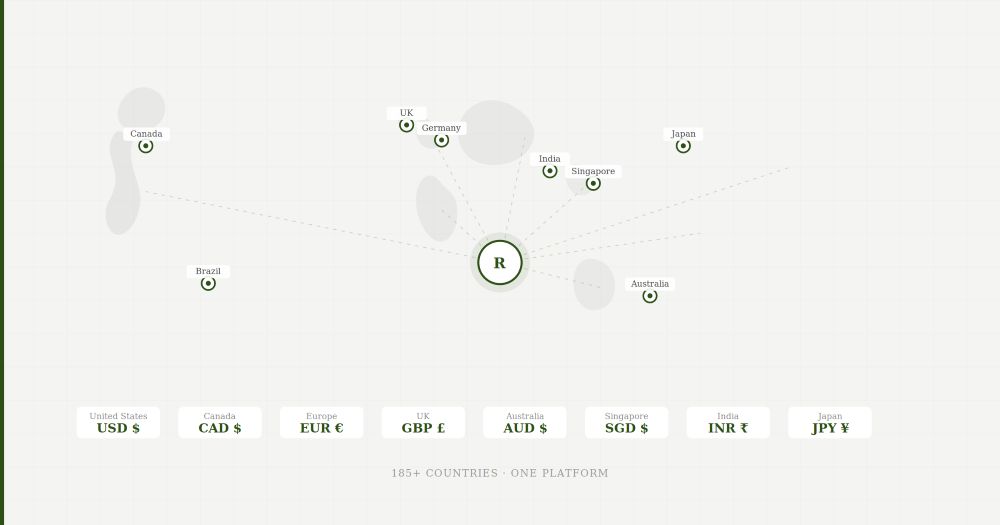
Rippling's global payroll offering covers over 185 countries through a combination of in-house infrastructure and local partnerships. For many mid-market companies, it's the compelling option because it closes the gap that makes international payroll operationally expensive in the first place: the disconnect between HR data and payroll data.
In a well-configured Rippling environment, the HR record is the payroll record. When you hire someone in Canada, their compensation, tax forms, and benefit elections are captured in the same workflow as their onboarding. When they receive a promotion, the compensation change propagates to payroll automatically, without a separate data entry step in a disconnected system. When they leave, the offboarding workflow terminates payroll access alongside app deprovisioning and device recovery — the same unified event that powers the security-aware offboarding model we've written about.
Rippling also covers the EOR layer directly, which is significant. For companies adding headcount in countries where they don't have entities, Rippling's EOR service plugs into the same platform — so an employee being managed through EOR in Singapore is in the same system as a direct employee in the US. When the Singapore headcount justifies a local entity, the migration path to direct payroll stays within the same platform rather than requiring a system switch.
The table stakes for any global payroll solution are automated statutory compliance: correct calculation and remittance of income tax withholding, social insurance contributions, statutory deductions, and year-end reporting across each covered jurisdiction. Rippling maintains country-specific tax tables and regulatory updates, covering jurisdictions from Canada and the UK to Germany, Australia, Singapore, India, and across Latin America.
For companies with employees in Canada specifically — a common first international hire for US-based companies — Rippling handles CPP/QPP contributions, EI premiums, federal and provincial income tax withholding, T4 and RL-1 year-end filing, and ROE generation on termination. The same unified data model that handles a US W-4 and Form 941 handles the equivalent Canadian obligations, in the same platform.
Currency management is handled natively: employees are paid in local currency, and Finance gets consolidated reporting in a base currency of their choosing. For companies doing multi-entity consolidation in their financial close, this eliminates one of the more tedious reconciliation steps.
Not every global payroll setup should run through a single unified platform. A few scenarios where a hybrid architecture still makes sense:
High-complexity in-country operations. Companies with large headcounts and complex payroll in a specific country — a German operation with 200 employees, union agreements, and multi-tier works council requirements — sometimes run best with a specialized local provider for that country, integrated into a unified platform for the rest of the portfolio. Specialized depth can matter more than unified simplicity when the compliance complexity is genuinely elevated.
Existing legal entity infrastructure. Companies that already have established payroll operations in several countries, with local HR and finance teams managing those relationships, may not realize efficiency gains from consolidation until a natural renewal cycle creates the opportunity to migrate. Forcing a migration to a unified platform when existing infrastructure is running well rarely pencils out.
Regulatory environments requiring local presence. A handful of countries — notably Brazil, and increasingly India and China at scale — have payroll compliance complexity that benefits from true local expertise. Understanding the nuance of when a unified platform's coverage is sufficient versus when local specialization is warranted is part of the architecture design work.
For most 50–500 person companies expanding internationally, though, the efficiency case for a unified platform is strong, and the operational argument for maintaining fragmented local vendor relationships weakens with every country added.
One of the underappreciated advantages of running global payroll through Rippling is the Finance integration. Rippling's payroll data connects natively to general ledger mapping and financial reporting, with configurable account coding by entity, department, and cost center. For companies on Rippling Spend, that integration extends to expense management and corporate card data as well.
The practical value: Finance and HR are looking at the same compensation data, in real time, across all geographies. When Finance is building the workforce cost model for a new country expansion, the data they need — current headcount, compensation by level and location, benefit costs — is in the same place HR manages it. The monthly payroll-to-GL reconciliation that typically requires a Finance analyst to manually match payroll reports against journal entries becomes significantly lighter. For how to connect these dots in Rippling's data model, our guide to Compensation Philosophy and Rippling's Compensation Bands covers the structural prerequisites.
The compliance risk in global payroll concentrates in a few consistent failure patterns. Understanding them is more useful than a general reminder to "stay compliant."
Worker misclassification. Classifying an employee as a contractor to avoid the cost and complexity of local employment law is the most common and most expensive global payroll mistake. Jurisdictions from Spain to Australia have become significantly more aggressive about contractor reclassification, with back-pay, social contribution, and penalty exposure that can dwarf the cost of proper employment from day one. If you have someone working full-time for your company in another country who "invoices" you monthly, this risk deserves immediate review.
Permanent establishment. Depending on the nature of the work and the contractual structure, employing workers in a foreign jurisdiction can create corporate tax presence — "permanent establishment" — triggering local corporate income tax obligations. This is primarily a legal and tax advisory conversation, but it starts with the payroll decision. The EOR model is partly a structural tool for avoiding inadvertent permanent establishment.
Statutory benefit non-compliance. Many countries mandate benefits — pension contributions, paid leave minimums, 13th month pay, redundancy entitlements — that don't have US equivalents. These aren't optional, and they're not always obvious from reading the surface-level employment law. A global payroll platform with up-to-date statutory benefit configuration for each covered jurisdiction handles this automatically; a DIY approach requires country-specific legal counsel to get it right and monitor it ongoing.
Data residency and privacy. GDPR and its analogs in Canada (PIPEDA/provincial equivalents), Australia, and other jurisdictions impose requirements on how employee personal data is stored, transferred, and processed. Payroll data is among the most sensitive employee data you hold. Understanding where your global payroll platform stores data and how cross-border data transfers are handled is a compliance question, not just a technical one. Our colleagues writing on identity and access management at thePeopleStack cover the access control side of this picture in more depth.
The efficiency gains of unified global payroll depend heavily on the quality of the HR data model underneath it. A few things that matter before you start building out global payroll configuration:
Clean entity structure. Rippling Global Payroll handles multi-entity configurations, but your entities need to be correctly mapped before you build payroll on top of them. If your legal entity structure is unclear, or if employees are assigned to entities based on historical accident rather than actual legal employment relationships, that needs resolving first.
Consistent job architecture. Payroll runs against job levels, compensation bands, and benefit plan eligibility rules. If your job architecture is inconsistent — people at the same level in different countries with different titles and inconsistently applied band logic — you'll build the same inconsistency into your global payroll configuration. Fix the architecture first; we cover why in the Compensation Philosophy post.
Tax form and withholding data collection. International payroll requires country-specific tax elections and identification data from employees. Building that collection into onboarding workflows — so it's captured before the first payroll run, not chased down afterward — is one of the highest-value operational improvements for companies expanding internationally.
If you're running Rippling today and adding global payroll, a Rippling HealthCheck is often the right starting point — it assesses whether your current data model and configuration will support global payroll cleanly, or whether there are structural issues to address first.
Global payroll is one of the places where the gap between "we have a system" and "we have a system that works" is most expensive. Fragmented local vendor relationships, disconnected HR and payroll data, and manual reconciliation are the norm for companies that built their international footprint incrementally — and the cost is absorbed so gradually that it's easy to not see it clearly until you do the math on finance team time, compliance exposure, and the errors that don't get caught until they're already expensive.
Rippling Global Payroll closes that gap for most mid-market companies by unifying the HR record and the payroll record — so the data entry, the compliance logic, and the reporting are in one place, not spread across relationships with four vendors who don't talk to each other. The decision to consolidate isn't always obvious from inside the current system. From outside it, it usually is.
If you're building out international operations or evaluating whether your current global payroll architecture is what you'd design today, the thePeopleStack team is a good place to start that conversation. We've helped mid-market companies design global payroll architecture from scratch and migrate to Rippling from fragmented multi-vendor setups — and the implementation work is only part of what that requires.



December 24, 2025
Career
It's 2026, and career ladders are breaking down as flatter organizations, faster skill change, and AI reduce traditional promotion paths. Research shows high performers now grow by expanding scope, building in-demand skills, moving laterally, and earning trust through outcomes—not by waiting for titles. Employees must manage careers as portfolios of skills and impact, while PeopleOps and HR must redefine growth around scope and mobility, enable managers in leaner orgs, and ensure fair access to opportunity or risk losing top talent.
Career


November 28, 2024
Compliance
Upcoming 2025 employment law changes in the U.S. and Canada will significantly impact businesses, but Rippling’s automated compliance tools and robust HR features can help organizations stay ahead and confidently adapt to evolving regulations.
Compliance


July 11, 2026
Compliance
Illinois is live, Colorado lands June 30, twenty states now regulate HR data, and a federal executive order is fighting all of it. Chasing each statute is a losing game. Here's the highest-common-standard posture that holds up regardless of how the fight resolves.
Compliance